Multimodal Motion Conditioned Diffusion Model for Skeleton-based Video Anomaly Detection
Proceedings of the IEEE/CVF International Conference on Computer Vision (ICCV) 2023
-
Abstract
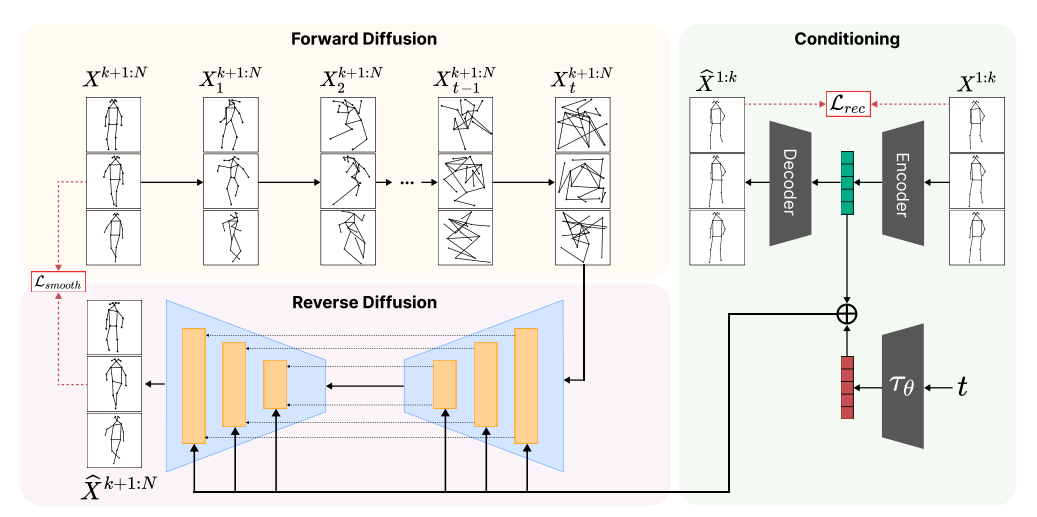
Anomalies are rare and anomaly detection is often therefore framed as One-Class Classification (OCC), i.e. trained solely on normalcy. Leading OCC techniques constrain the latent representations of normal motions to limited volumes and detect as abnormal anything outside, which accounts satisfactorily for the openset’ness of anomalies. But normalcy shares the same openset’ness property, since humans can perform the same action in several ways, which the leading techniques neglect. We propose a novel generative model for video anomaly detection (VAD), which assumes that both normality and abnormality are multimodal. We consider skeletal representations and leverage state-of-the-art diffusion probabilistic models to generate multimodal future human poses. We contribute a novel conditioning on the past motion of people, and exploit the improved mode coverage capabilities of diffusion processes to generate different-but-plausible future motions. Upon the statistical aggregation of future modes, anomaly is detected when the generated set of motions is not pertinent to the actual future. We validate our model on 4 established benchmarks: UBnormal , HR-UBnormal, HR-STC, and HR-Avenue, with extensive experiments surpassing state-of-the-art results.
Citation
If you find this work useful in your research, please cite our paper:
@inproceedings{flaborea2023mocodad,
  title = {Multimodal Motion Conditioned Diffusion Model for Skeleton-based
             Video Anomaly Detection},
  author = {Flaborea, Alessandro and Collorone, Luca and D’Amely Di Melendugno, Guido Maria and D'Arrigo, Stefano and Prenkaj, Bardh and Galasso, Fabio},
  booktitle = {Proceedings of the IEEE/CVF International Conference on Computer
                 Vision (ICCV)},
  year = {2023},
  pages = {10318-10329},
  bibtex_show = true,
  url = {https://arxiv.org/abs/2307.07205}
}